
Hotel reputation work starts before checkout. Accurate listing details set expectations, and a guest who tells reception about a noisy room gives the team a chance to help during the stay. After checkout, reviews and private comments show what the team should look into next.
What hotel reputation management means in practice
- Keep the official profiles accurate so guests can find the right property and know what to expect.
- Recover in the stay when something is still fixable: a room move, a delayed check-in, a missed amenities request.
- After checkout, offer private feedback and, separately, official public review links, without incentives or gating.
- Read new reviews on Google, Tripadvisor, Booking.com and, where it applies, Airbnb.
- Reply in public on each platform, with a human checking the text.
- Once a week or once a month, look at repeating themes: cleanliness, noise, check-in, breakfast, maintenance.
The stay cycle, from expectation to public review
Pre-stay expectations are set by photos, descriptions and the reviews a guest has already read. If the listing over-promises, later comments will say so. Fix the listing, do not only answer the review.
During the stay, ask reception to record what the guest reported and what the team offered. If the same guest posts later, check that note before replying.
After checkout, give guests a clear choice of where to share their experience.
- Private feedback, for anything the guest wants you to handle directly.
- Public reviews, through official links or QR codes for Google and Tripadvisor. For Booking.com stays, guests receive an invitation from Booking.com.
Do not hide the public links from guests who were unhappy. Do not offer a discount or an upgrade in exchange for a review or for taking one down. Official Google help prohibits incentives in exchange for posting, changing or removing Google reviews. Keep the same ethic on the other platforms.
The three main platforms, and how their scores differ
Google, Tripadvisor and Booking.com all collect guest comments, but they do not measure the same thing. Treat each score as its own system.
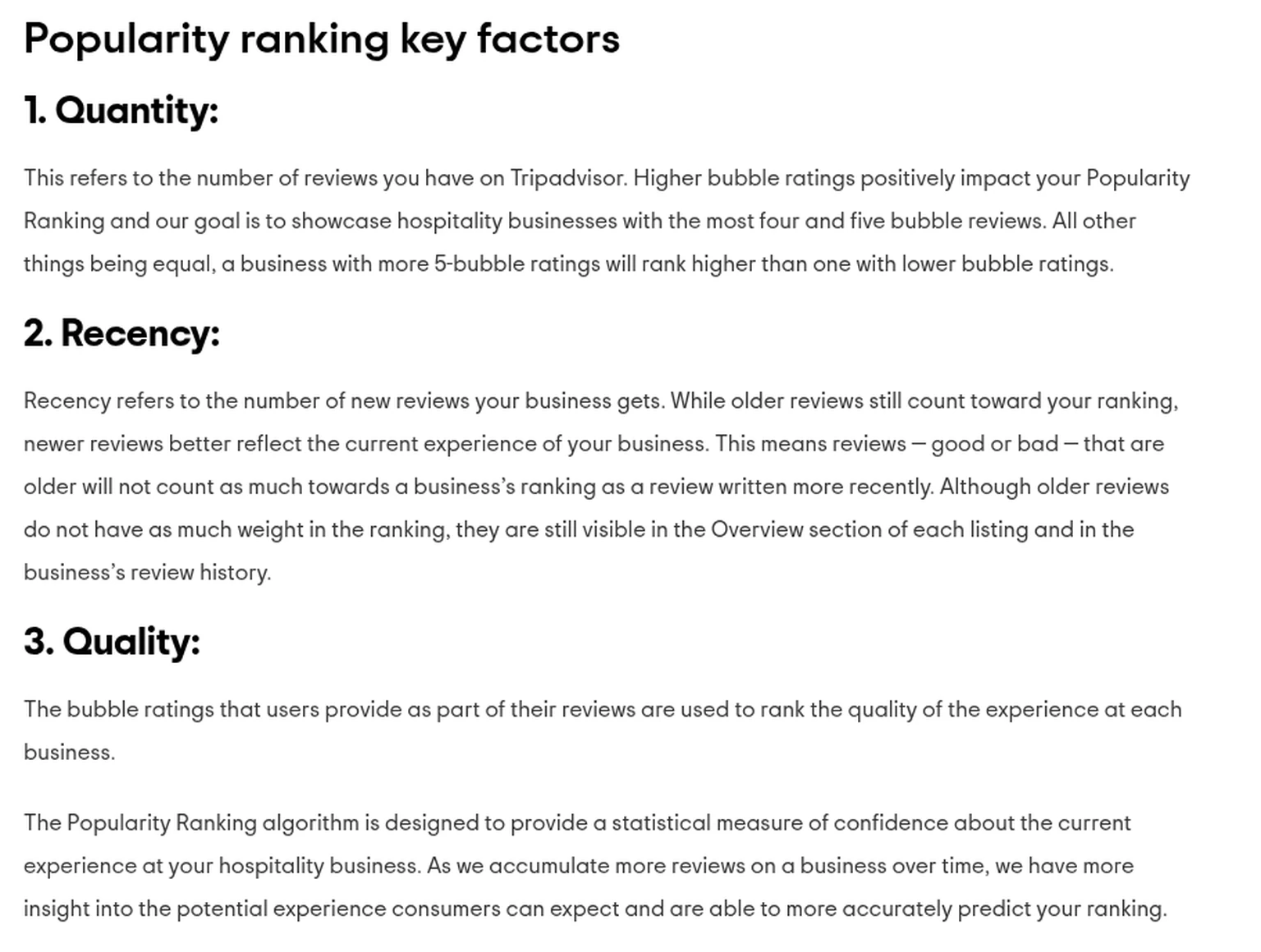
Source: Tripadvisor Business Insights.
Tripadvisor ranks businesses relative to others in their location. Its guidance describes quantity, recency, quality (bubble ratings) and consistency over time. See how Tripadvisor rankings work.
Booking.com uses an overall score from 1 to 10 and gives guests 90 days to review after checkout. Since January 2025 it has weighted scores by recency. Category ratings such as wifi or breakfast stay separate. Reviews are archived after 36 months, and the score is recalculated from those still online. See how the Booking.com review score is calculated.
Google reviews live on the Business Profile and on Maps. Official help covers the official request link or QR code, the requirement to verify before you reply, and the fact that Google reviews your public reply before it is posted. See how to get more Google reviews and how to respond to Google reviews.
A 30-day plan for a small hotel
You can run this without a full reputation suite. Adjust the days to your arrival pattern.
Days 1 to 3. Confirm that Google, Tripadvisor and Booking.com profiles are verified and point at the right property. Copy official review links or QR codes. Test them on a phone that is not signed in as the hotel.
Days 4 to 7. Write one honest request sentence for checkout and one for the post-stay email. Remove any 5-star prompt or reward language. Train the desk to ask once, calmly, and not to hover.
Days 8 to 14. Catch up on unanswered public reviews from the last month. Start with recent complaints. Check facts before you write. Keep room numbers and medical details out of public replies.
Days 15 to 21. Read the last 30 to 50 comments as a set, across the platforms you use. Write down three repeating themes and give each one an owner (housekeeping, maintenance, the desk, breakfast).
Days 22 to 30. Check whether each owner made the agreed change. Read new comments to see if guests still mention the same issue.
If you need help reading reviews across sites, see the hotel reputation management software guide. For a routine you can use with any tools, see hotel review operations.
Example of a check-in complaint
Imagine a 28-room independent hotel with repeated comments about slow check-in between 4 and 7 pm and occasional reports of broken bathroom extractor fans.
The manager reads the last month of Google, Tripadvisor and Booking.com comments and counts how many mention check-in waits or bathroom fans. She does not average the three platform scores. She gives check-in to the front office (an extra person on the desk in that window, or a clearer arrival-time note at booking) and bathroom fans to maintenance, with a date to inspect the rooms that were named in private feedback.
In public replies, the manager acknowledges the wait or the fan and mentions completed changes when relevant. Room numbers stay private. A week later, she checks whether the work happened and whether guests still report the issue.
If you’re deciding where to start, compare your recent reviews with the hotel guest complaints guide. The guest satisfaction survey template gives the front desk a private way to ask about the same issues.
Who owns which part of the work
In a small hotel, one person often wears every hat. Even then, write the names down. When the same person is the desk, the reviewer of comments and the owner of maintenance, themes get answered in public and then forgotten.
Scroll to see more columns.
| Work | Typical owner in a small hotel | What “done” looks like |
|---|---|---|
| Official profiles and review links | General manager or front office | Links tested on a guest phone this month |
| In-stay recovery | Duty manager on the shift | A note of what was offered, without waiting for the review |
| Public replies | A named person who can speak for the hotel | Complaints from the last week have been answered or are waiting on facts |
| Theme list | General manager, with department heads | Two or three themes, each with an owner and a next step |
| Private feedback follow-up | The person who received the comment, or a named deputy | A closed note, or a reason it is still open |
What to track if you run one hotel or a small group
For each property and platform, record how many reviews came in during the period, the share with a low score on that platform and the share you’ve replied to. Keep the review window and the platform’s rating scale beside each number. Compare similar periods and note anything that changed, such as a renovation or a different mix of guests.
If you manage two to four properties, use the same topic names across the group so managers can compare issues such as late room readiness. Keep the review counts alongside those topics. A complaint at a property with few reviews is worth checking locally before deciding it calls for a group-wide change.
Sources
- Tripadvisor popularity ranking key factors: https://www.tripadvisor.com/business/insights/resources/tripadvisor-popularity-ranking-key-factors-and-how-to-improve-it (used in the ranking explainer, official text opened 19 November 2026)
- Booking.com partner help on guest review scores: https://partner.booking.com/en-us/help/property-guest-experience/reviews/everything-you-need-know-about-guest-review-scores (opened 19 November 2026)
- Google Business Profile help on requests and replies: https://support.google.com/business/answer/16816815?hl=en, https://support.google.com/business/answer/3474050?hl=en (opened 19 November 2026)
What you miss when hotel reviews stay in separate tabs
The weekly review can miss the same check-in complaint if it appears once on Google and once on Booking.com. Reviato brings those reviews together so the front desk can read the details before the next arrival rush. It also gives guests a private way to tell the hotel about a problem during the stay. Request a free hotel review audit.