
Tripadvisor’s popularity ranking compares businesses in the same place and category. Tripadvisor’s guidance names the quantity, recency and quality of reviews and explains how the ranking aims for consistency over time.
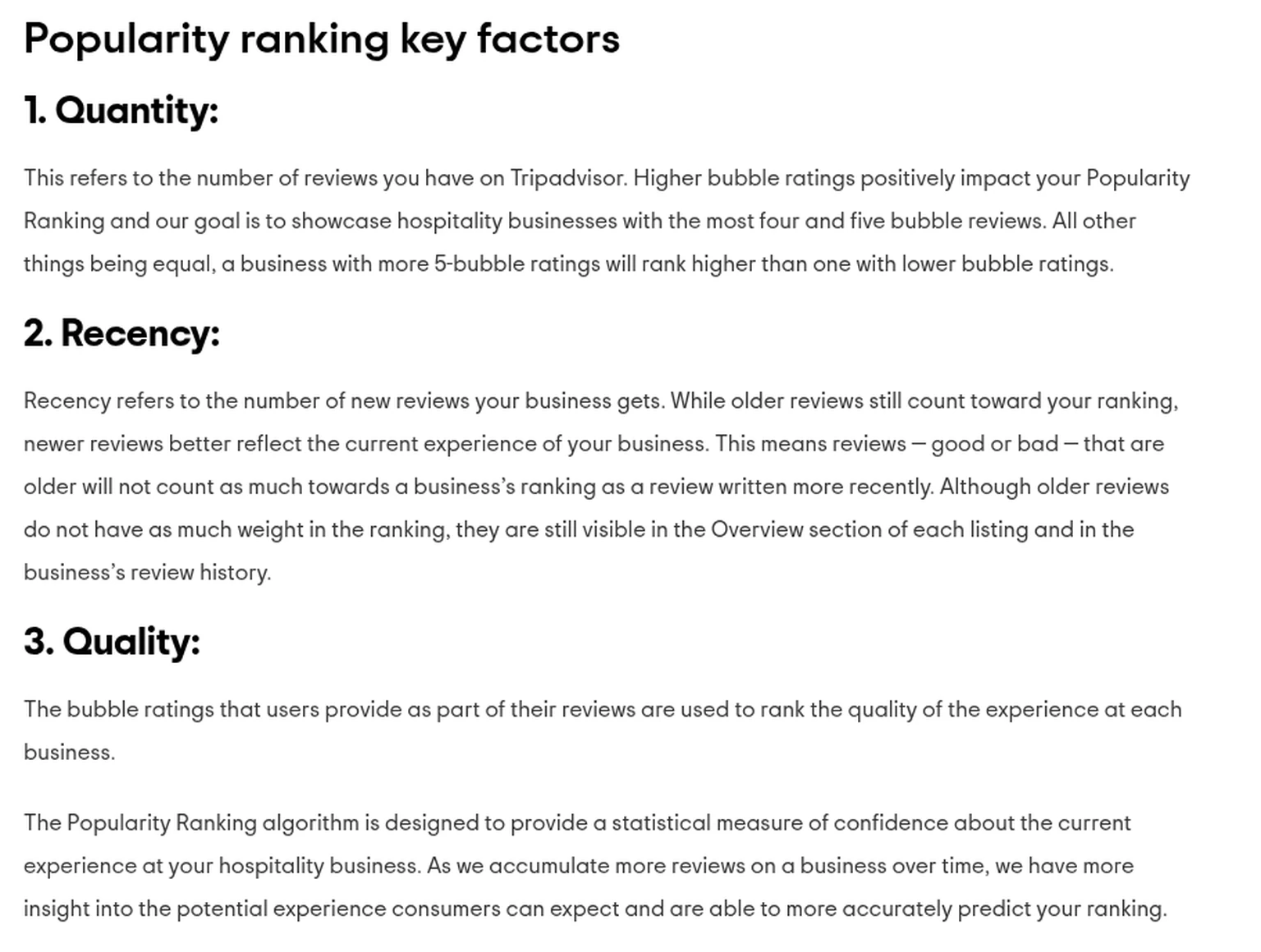
Source: Tripadvisor Business Insights.
What the popularity ranking measures
Tripadvisor says the popularity ranking compares hospitality businesses based on popularity, so travellers and diners can find places that match a search. Official help says the ranking is based on user reviews and reflects your standing against other businesses in your geographical location. It also says that the closer you are to the top, the more likely it is that users will see your business when they search your area.
Official factors, in operator language
Quantity. This is the number of reviews on Tripadvisor. Official help says higher bubble ratings positively impact the ranking, and that Tripadvisor aims to showcase businesses with the most four- and five-bubble reviews. All other things being equal, a business with more 5-bubble ratings will rank higher than one with lower bubble ratings.
Recency. Newer reviews count more than older ones, because they better reflect the current experience. Official help says older reviews, good or bad, do not count as much as a more recent review. Older reviews are still visible on the listing and in the review history.
Quality. The bubble ratings in the reviews are used to rank the quality of the experience.
Confidence over time. Official help says the algorithm is designed to provide a statistical measure of confidence about the current experience, and that more reviews over time give a clearer picture. Later changes, the page says, have focused on promoting more consistency in the rankings, so a business’s performance relative to others in its location is reflected over time, regardless of size or the rate at which it collects reviews.
Tripadvisor’s guidance leaves the exact weighting unpublished.
What you can work on this month
Official help says the ranking is based solely on user feedback, and that consistently collecting new, high-quality reviews is the best way for businesses to improve their position over time. It also says to focus on the guest experience first.
In practice, that means:
- Fix repeating problems you can see in the comments (cleanliness, check-in, noise, accuracy).
- Ask for honest reviews at a sensible time, without incentives or gating. See how to ask for Tripadvisor reviews.
- Reply on Tripadvisor when you have something useful to tell future guests. Keep private guest details out of the reply.
- Track rank next to new-review volume and the mix of low ratings, but do not assume one weekly change caused a rank movement.
Ask for honest reviews from all guests. See why you should avoid buying Tripadvisor reviews.
About the awards
Travelers’ Choice is an award programme, explained on Tripadvisor’s own award pages. Eligibility and winners are not a substitute for the popularity ranking factor list. If you mention an award on your own site, follow Tripadvisor’s current award rules and dates.

Source: Tripadvisor Travelers’ Choice Hotels.
See Tripadvisor statistics for company-scale figures from the 2025 Annual Report (Form 10-K) and the source for review and moderation totals.
Sources
- Tripadvisor, “Tripadvisor Popularity Ranking: Key Factors and How to Improve it”, updated 18 November 2024 and accessed 19 November 2026.
- Tripadvisor Travelers’ Choice: https://www.tripadvisor.com/TravelersChoice and https://www.tripadvisor.com/TravelersChoice-Hotels
What a ranking change can hide
Your ranking shows where the listing sits today. Without reviewing the comments again, the team can miss the recurring noise or service issue that deserves attention regardless of rank. Reviato groups the reviews by topic and keeps the original wording available. See how review trends work.