
Introduction
If you are working on google maps Restaurants reviews london, you are competing in a city where a quick search decides where people eat. Most locals check Google Maps first when choosing where to go, and they trust the rating and volume they see in seconds. That makes your listing as important as your front door.
This guide breaks down what the data says about London Restaurants on Google Maps, using a real sample of 100 listings. You will see how ratings are distributed, what drives complaints and praise, and which actions move the needle without wasting time. It is written for owners who want a clear path, not a long checklist.
You will also get a short comparison to TripAdvisor, plus a simple weekly and monthly plan you can follow. If you want more city-wide context, start with London restaurant insights. Next, look at how your listing stacks up to the numbers below.
The google maps Restaurants reviews london landscape
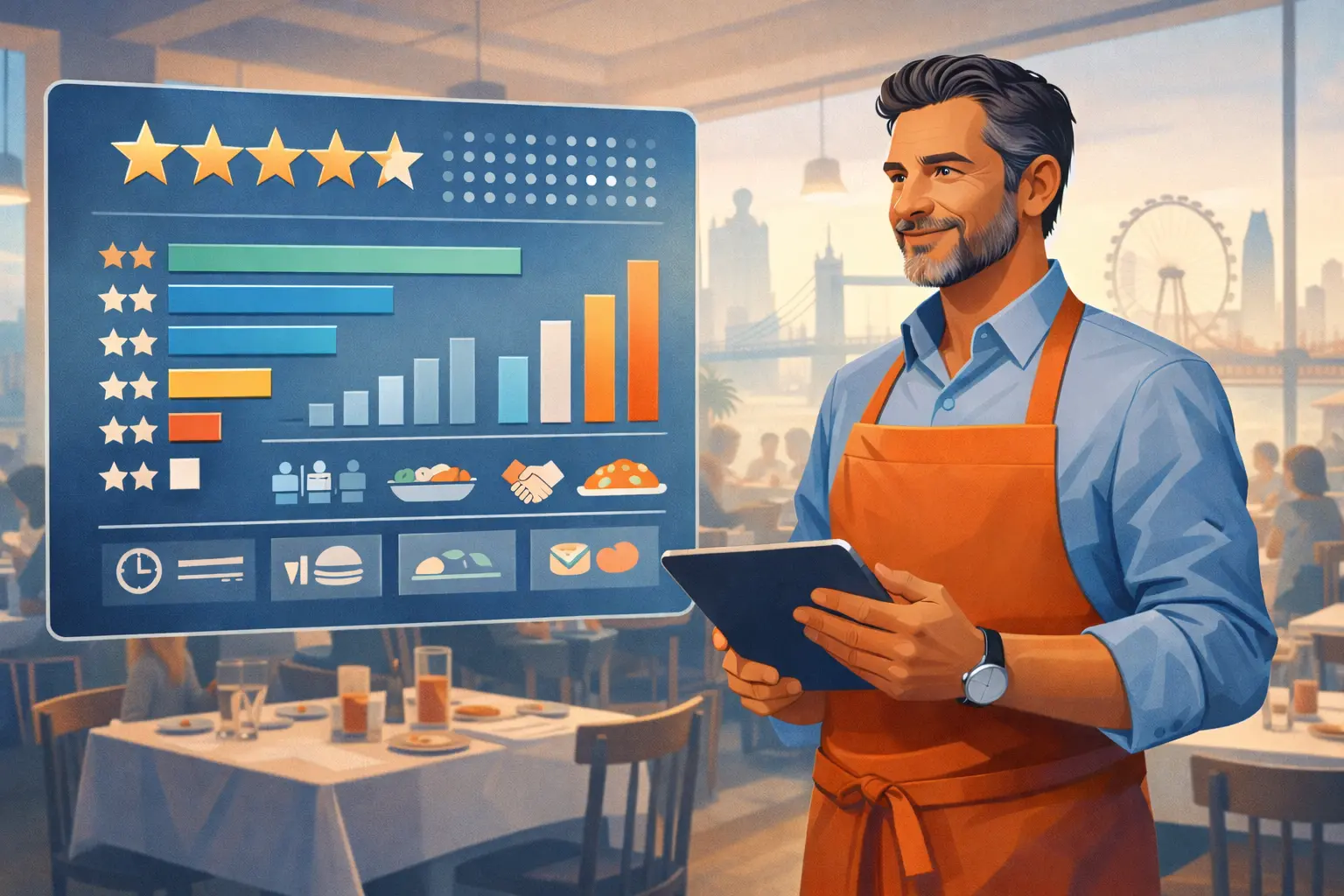
| Rating | % of Restaurants |
|---|---|
| 5-star | 71% |
| 4-star | 13% |
| 3-star | 6% |
| 2-star | 3% |
| 1-star | 7% |
The distribution is top-heavy. Most London Restaurants sit at 5-star, with a smaller slice at 4-star. That means average is not enough. The city-wide average rating is 4.53 stars, and the average review count is 3271.53 reviews per restaurant. To stand out, you need to stay at 4.5 or higher and keep volume growing so your listing looks active.
The google maps rating is also tied to search visibility. The “near me” algorithm favors listings that look recent and trusted, which means reviews, photos, and accurate hours matter more than a perfect menu photo. That is why london Restaurants reviews are not just about reputation, they are about discovery when someone is nearby and hungry.
If your numbers trail the averages, start by tightening the basics, then add one growth habit from the strategy section. That gives you a clear next step without overhauling everything at once.
Revenue impact of google maps Restaurants reviews london
Ratings and review volume drive demand. When your score stays at or above the average 4.53 stars and your review count keeps climbing, customers see a safer choice. That usually means more walk-ins, more repeat visits, and a little more room to hold price without pushback. If your listing looks quiet, people move on fast, especially in busy areas.
Small, steady improvements compound. If you reply to reviews, refresh photos, and keep hours accurate, you build a pattern that Google Maps rewards. Over time, that lifts both visibility and the confidence customers feel before they book or walk in.
Your target is not perfection. It is a stable google maps rating and a review count that grows each month, so the listing signals momentum. Pick one action you can repeat weekly, and do it on the same day every week.
What London customers complain about on Google Maps
- Long waits and slow service for seating or food delivery (23% of negative reviews)
- Small portions or overpriced meals for the quality (20% of negative reviews)
- Food quality issues like bland flavors or dishes served cold or overcooked (17% of negative reviews)
These themes point to operational friction more than marketing issues. People are not complaining about decor or branding. They are talking about wait times, value, and food execution. That tells you where to focus when you want to improve google maps presence in a way customers notice.
Even mixed feedback can show the gap between promise and reality. This 4-star review is mostly positive but still points to expectations that were not met.
“The service was excellent. The portions were generous, but they were thin and easy to finish. The taste was good, but it didn’t quite meet my expectations, felt a bit overhyped”
Google Maps reviews are shorter and more immediate than other platforms. People often post right after the meal, which means the last shift matters. You can use that to your advantage by fixing the one complaint that shows up most often and tracking it over a few weeks.
Focus on the complaint that appears in your last 20 reviews, and decide which small operational change you can test first.
What drives 5-star reviews
- Friendly, attentive staff and standout service (38% of 5-star reviews)
- Delicious food, especially pizzas, pasta, and steaks (34% of 5-star reviews)
- Great atmosphere and lively ambience (18% of 5-star reviews)
Service leads the praise list, which matches what diners remember most. Strong hospitality makes even a simple meal feel special, and it shows up in your london Restaurants reviews quickly. Food quality is close behind, and atmosphere matters when customers choose between similar menus.
These quotes capture what people say when the experience lands.
“Proper Italian pizza done right. Excellent dough, light, and easy to digest, with top quality ingredients and perfectly balanced flavours. You can taste the attention to detail in every pizza. One …”
“… I would especially like to commend Amalia, the staff member; she was e…”
Use this as a checklist for what to protect during busy shifts. Keep hospitality, food execution, and atmosphere in balance, and the review trend follows. Choose one service habit to reinforce this week and share it with the team before service.
Five Google Maps-specific strategies to improve google maps presence
Strategy 1: Optimize Your Business Hours
Hours are one of the fastest signals of trust. If your hours are wrong, you lose near-me searches and get frustration in reviews. With an average of 3271.53 reviews per restaurant in London, diners have many options, so accuracy matters.
Action steps:
- Audit hours in Google Maps and your website so they match (10 minutes)
- Add special hours for holidays or private events as soon as they are set (10 minutes)
- Set a reminder to review hours monthly (5 minutes)
This prevents avoidable complaints and keeps your listing active. Start by checking today’s hours and updating any mismatch.
Strategy 2: Respond to Reviews Within 24 Hours
Quick replies show you are present and help future diners decide. With 71% of restaurants at 5-star, the difference is often how owners handle the outliers. Timely replies can soften negative impressions and reinforce the praise that already sells you.
Action steps:
- Set a daily review check time on your calendar (5 minutes)
- Thank 5-star reviewers with a specific detail from their visit (5 minutes)
- For complaints, acknowledge the issue and offer a next step (10 minutes)
You save time by batching and prevent problems from piling up. Pick a time today and make it your daily review window.
Strategy 3: Add Photos Weekly
Google Maps rewards fresh photos because they show what the experience looks like now. That matters when customers compare a 4.53 average listing to one that feels more current. Photos also set expectations around portion size and atmosphere, which link directly to complaints and praise.
Action steps:
- Take a few photos during a normal service, not just a styled shoot (15 minutes)
- Add at least one exterior photo to reduce confusion on arrival (10 minutes)
- Highlight top dishes that match what diners praise, like pizza, pasta, or steaks (15 minutes)
Consistent updates make your listing feel alive without a big time cost. Put a short photo slot on the weekly prep list.
Strategy 4: Use Google Posts for Specials
Google Posts are visible in your listing and help you stand out in a crowded search. They also give customers a reason to choose you now, which can lift review volume over time. Small posts can steer diners to quieter days without discounting your menu.
Action steps:
- Post one weekly special tied to a time window (15 minutes)
- Add a clear photo and a short line about what to expect (10 minutes)
- Rotate posts based on what gets the most clicks (10 minutes)
This keeps your listing active and helps you guide demand. Draft the first post right after reading this section.
Strategy 5: Ask for Reviews at the Right Moment
The best time to ask is when the guest just said they had a great experience. That is when service and food quality are fresh, and it aligns with what drives 5-star reviews. A quick ask can increase volume without pressure.
Ask right after payment or a compliment, and keep it short so it feels natural.
Action steps:
- Train one line staff can use in the moment (10 minutes)
- Add a small reminder near the register or checkout flow (10 minutes)
- Follow up with a polite link for reservations or large parties (10 minutes)
This creates a steady stream of fresh reviews and helps you move toward the city average. Choose a simple ask and practice it with the team today.
Platform comparison insight for google maps Restaurants reviews london
Google Maps drives more walk-in traffic in London, especially for lunch and last-minute plans. TripAdvisor tends to influence travelers and planned visits, so it is worth tracking, but Google Maps should stay the priority for daily demand. If you want the TripAdvisor view, use the TripAdvisor review guide for London restaurants.
For a wider view across platforms, compare your results with the London cross-platform review summary. Keep your main focus on Google Maps and check the other platforms once a month.
Next steps
This week, check your rating, read your last 20 reviews, and pick one complaint to fix. Tie it to the top issues in the data so you work on what customers talk about most. Keep it tight and realistic so it gets done.
This month, implement the fix, ask for reviews at the right moment, and monitor results weekly. Use a simple tracker so you can see movement in your google maps rating and review count without extra tools.
This quarter, compare rating and revenue trends, then repeat the process with the next complaint. If you want a light tool to track reviews, our review tool can help you keep an eye on patterns without extra admin.
Data methodology
This article uses Google Maps public reviews from a sample of 100 restaurants in London, England. The collection date was December 2025, and the data reflects a single snapshot in time. Results vary by location, service style, and customer mix.
The platform in this analysis is Google Maps only, with a separate TripAdvisor analysis available. All data is publicly verifiable via Google Maps, and the insights are meant to guide action rather than predict outcomes.
Use this as a baseline, then compare it to your own recent reviews to pick the next operational improvement.