
1. Introduction
Running a restaurant in Dublin means the phrase google maps Restaurants reviews dublin can decide tonight’s walk-ins. Most locals check Google Maps first when choosing where to eat, especially for lunch or a last-minute dinner. If your listing looks stale, they move on.
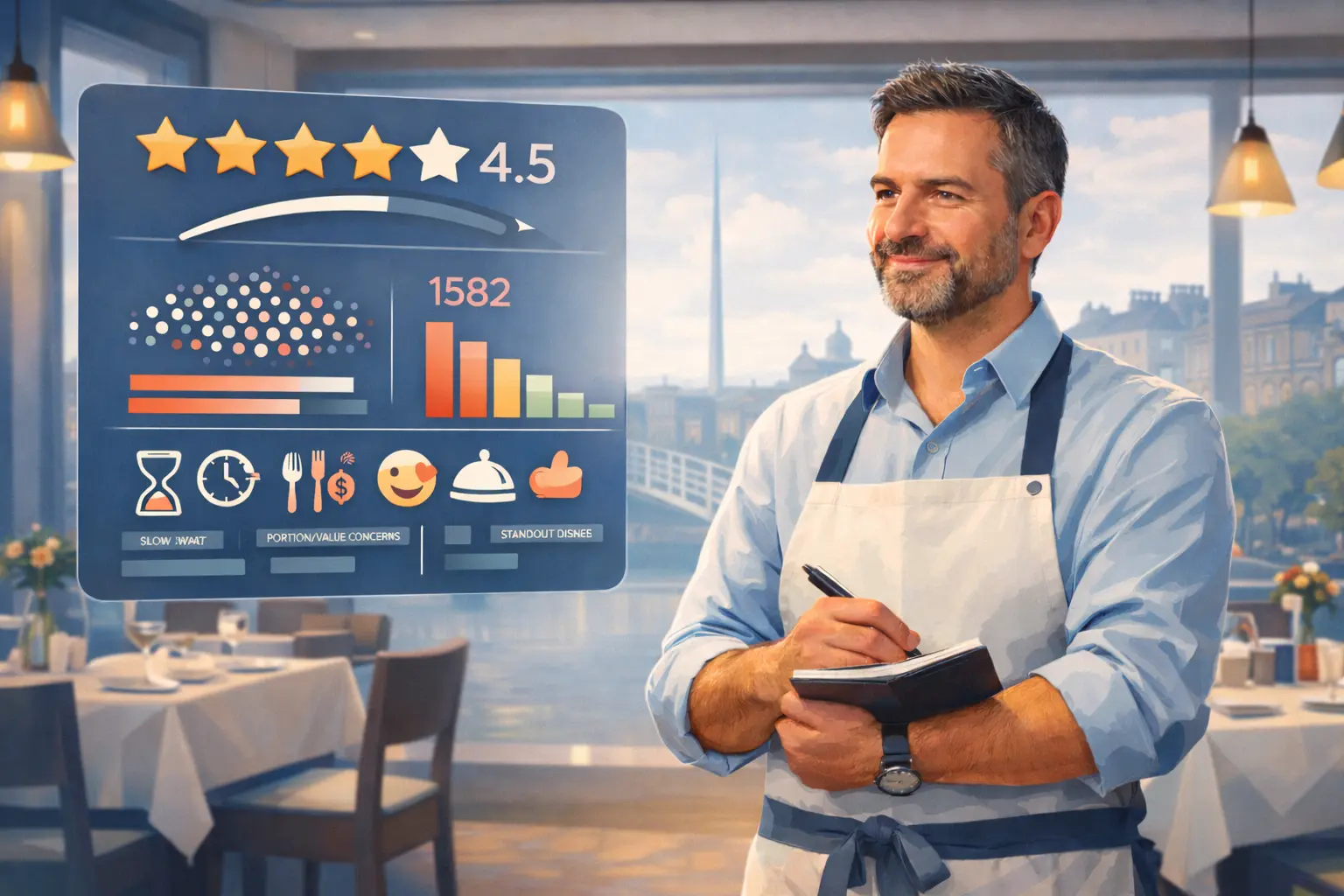
This guide uses public Google Maps data from 100 Dublin restaurants collected in January 2026. The average google maps rating is 4.5★ with 1582.18 reviews per restaurant, so guests expect proof and fast responses. Keep the Insights hub open if you want to compare how other cities perform.
We will cover the local rating landscape, the revenue impact of reviews, what Dublin customers complain about, and what earns 5-star praise. Then you get five Google Maps-specific strategies, a platform comparison, and a tight plan for the next quarter. Next step: write down your current rating and review count before you start.
2. The Google Maps Landscape for Dublin Restaurants Reviews
| Rating | % of Restaurants |
|---|---|
| 5★ | 70% |
| 4★ | 13% |
| 3★ | 5% |
| 2★ | 3% |
| 1★ | 8% |
Dublin looks strong on paper in this dublin Restaurants reviews snapshot, with 70% of restaurants sitting at 5★ and an average rating of 4.5★. The average review count is 1582.18 per restaurant, which means guests treat volume as proof, not a nice-to-have. To stand out, you need to stay at 4.5★ or higher and keep new reviews coming in, not just once a quarter. If you want the full city listing view, use the Dublin restaurants insights index.
The Google Maps “near me” algorithm favors proximity, relevance, and recent activity, so fresh signals help you surface first. When your hours, photos, and replies stay current, your listing looks alive and more reliable than the spot that has not posted in months. A steady google maps rating above 4.5 and a visible review stream are the simplest signals you can control. Next step: confirm your listing has updates from recent days.
3. Revenue Impact
Review volume and ratings shape demand and pricing power in a very direct way. With 1582.18 reviews on the average listing, even a small dip stands out, and a small rise attracts the cautious diner. What is the gap between a solid listing and a great one in Dublin? It is often the difference between being the safe choice and being the place people talk about when they head into town.
Higher ratings compound because each strong week feeds the next. A slightly better google maps rating brings more clicks, which brings more footfall, which brings more reviews if you ask at the right moment. That loop is how a steady 4.5★ can climb without heavy discounting. Next step: pick a realistic improvement goal for the next quarter and share it with your team.
4. What Dublin Customers Complain About on Google Maps Reviews
- “Slow service and long waits for seating or food” (18% of negative reviews)
- “Overpriced meals or small portions for the price” (13% of negative reviews)
- “Food quality issues like cold dishes, dryness, or undercooking” (11% of negative reviews)
These themes show where pressure builds during a typical service. Slow service is the top complaint, and it is the kind that shows up on busy weekends and midweek staffing gaps. Value concerns and food quality issues follow closely, which tells you that pacing, portion control, and consistency are daily levers, not seasonal fixes.
“AVOID ! My family waited 30 minutes to place an order. Afterwards we were waiting over 45 minutes for the food which didn’t arrive. Due to this we cancelled and ate elsewhere.
The double doors ups…”
Google Maps reviews are shorter and more immediate than many other platforms. People post them on the walk out, while the frustration is still warm and specific. That means you get real operational feedback fast, but it also means one chaotic service can drag your profile for weeks. Next step: choose one shift this week to time ticket flow and seating waits so you can isolate where delays start.
5. What Drives 5-Star Reviews
- “Delicious food with standout dishes like burgers, pasta, steak, and seafood” (45% of 5★ reviews)
- “Friendly, attentive staff and excellent table service” (30% of 5★ reviews)
- “Cozy atmosphere and inviting ambiance” (20% of 5★ reviews)
Food is the main driver of praise, and diners often name a specific dish that anchors the memory. Service is the second strongest theme, which shows that a warm greeting and a sharp refill routine still matter in a busy room. Atmosphere rounds it out, meaning lighting, music, and small touches are not just decoration, they are review fuel.
“Recently dined in 3brothers with my daughters, the food was incredible especially the tenders the were the nicest I’ve ever tasted the service was really good we were served by a girl named Chloe a…”
The strongest reviews connect great food, good pacing, and a clear human moment, like a server taking care of a family. When you align those three, your team starts earning repeatable, credible 5-star reviews. Next step: pick a signature dish and a service ritual to highlight in pre-shift for the next few weeks.
6. 5 Google Maps-Specific Strategies
Strategy 1: Optimize Your Business Hours
Accurate hours are a quiet ranking signal and a major trust cue. When 8% of Dublin restaurants sit at 1★, you cannot afford avoidable walk-ups to a closed door or a kitchen that actually shut early. Clear hours also reduce the slow-service complaints that rise when guests arrive during a half-open service window.
Action steps:
- Compare posted hours against recent weeks of POS close times (15 minutes).
- Update holiday and bank holiday hours every Sunday (10 minutes).
- Add “kitchen closes at” and “last seating” notes in your attributes (5 minutes).
- Confirm changes with the manager on duty before the weekend rush (3 minutes).
Time saved later: about 30 minutes a week in phone calls and apology replies. Next step: set a calendar reminder for the same time each week to update hours.
Strategy 2: Respond to Reviews Within 24 Hours
Fast responses show you are active and keep the conversation balanced, especially when 18% of negative reviews mention slow service. With an average of 1582.18 reviews per listing, even a few new replies can move the tone of your first screen. Quick responses also help you recover from value complaints before they harden into a pattern.
Action steps:
- Block a daily 15-minute slot to read and respond to new reviews (15 minutes).
- Start with a short thank you, then address the specific issue or dish mentioned (5 minutes).
- Offer a clear fix for wait times, like a new seating update text or host check-in (5 minutes).
- Log repeated themes in a shared note so your team can fix them weekly (5 minutes).
Rotate review replies across managers so your tone stays human and you avoid burnout.
Strategy 3: Add Photos Weekly
Photos help you improve google maps presence because they show freshness and reinforce the cozy, inviting atmosphere praised in 20% of 5★ reviews. A weekly post tells Google your listing is active, which supports “near me” visibility. It also gives diners a quick sense of what to expect before they tap directions.
Action steps:
- Take fresh photos during service: a dish, a table, and the room (10 minutes).
- Upload photos every Monday morning so they stay near the top (5 minutes).
- Add a short caption that matches the dish or mood you want to sell (5 minutes).
- Remove outdated seasonal photos so the set stays current (5 minutes).
Total time: about 25 minutes a week. Next step: pick one staff member to capture a photo during each shift.
Strategy 4: Use Google Posts for Specials
Posts are short, but they work as quick proof that your menu is alive. With 45% of 5★ reviews praising standout dishes, a weekly post helps you reinforce what you want people to order. It also gives the algorithm another signal that your listing is active, which supports visibility when locals browse.
Action steps:
- Post a signature dish or lunch special every week (10 minutes).
- Add a clear price and availability window to set expectations (5 minutes).
- Use a photo from your weekly upload so visuals stay consistent (3 minutes).
- Track clicks and calls for each post to learn what sells (10 minutes).
Time estimate: under 30 minutes per week. Next step: plan the next few posts during a quiet service block.
Strategy 5: Ask for Reviews at the Right Moment
Seventy percent of Dublin restaurants in the sample sit at 5★, so the difference is volume and timing. Asking right after a good moment, not at the end of a tough meal, keeps your rating steady and grows volume. That steady stream protects your average when a rare 1★ shows up.
Action steps:
- Ask right after a compliment or finished plate, not at the door (5 minutes).
- Use a short script and a printed QR card so staff stay consistent (10 minutes).
- Focus on tables that had smooth pacing and full orders (5 minutes).
- Track daily asks in a shift log so you can coach what works (5 minutes).
Time estimate: about 25 minutes per day across the team. Next step: start with a single shift this week and compare review volume after a week.
7. Platform Comparison Insight: Google Maps Reviews vs TripAdvisor in Dublin
Google Maps is the faster loop for Dublin restaurants because it drives more walk-in traffic and last-minute choices. TripAdvisor leans toward planners and visitors who read longer reviews and compare several places. That means Google is where you fix operational speed and consistency, while TripAdvisor is where you shape expectations for visitors.
If you want the platform-specific contrast, use the TripAdvisor guide for Dublin restaurants. Prioritize Google first for daily traffic, then tighten TripAdvisor once the big complaints are under control.
8. Next Steps
This is a small, repeatable plan that respects how busy a Dublin dining room can be.
- This week: check your rating, read your last 20 reviews, and pick one complaint to fix first.
- This month: implement the fix, ask for reviews at the right moment, and monitor ratings weekly.
- This quarter: track rating and revenue together, then repeat the cycle for the next complaint.
If you want one place to track reviews and response timing, our review tool can help. Start with Reviato and keep the focus on what moves your rating with the least time.
9. Data Methodology
Data source: Google Maps public reviews. The sample covers 100 restaurants in Dublin, County Dublin, collected in January 2026. This article is Google Maps only, with a separate TripAdvisor analysis available for platform comparison.
This is a snapshot in time, so individual results will vary by neighborhood, season, and service model. All data points are publicly verifiable on Google Maps. Use the numbers as a benchmark and track your own trends month to month.