
1. Introduction
In Miami, a dinner decision happens on a phone between a beach stop and a Brickell meeting. google maps Restaurants reviews miami data shows how that quick choice is shaped by ratings and fresh feedback. Most locals check Google Maps first when choosing where to go, so your listing is the first impression before the host says hello.
This guide focuses on Google Maps only, using public reviews from 100 Miami restaurants collected in December 2025. The average google maps rating in this sample is 4.7★, so the bar is high. You will see the rating distribution, what it takes to stand out, and how review volume links to pricing power. If you want wider context, keep the Insights hub open.
We also cover the biggest complaint themes, what drives five-star praise, and five platform moves you can run without extra staff. A short comparison with TripAdvisor and a simple action plan close it out.
2. The Google Maps landscape for google maps Restaurants reviews miami
| Rating | % of Restaurants |
|---|---|
| 5★ | 78% |
| 4★ | 8% |
| 3★ | 4% |
| 2★ | 2% |
| 1★ | 8% |
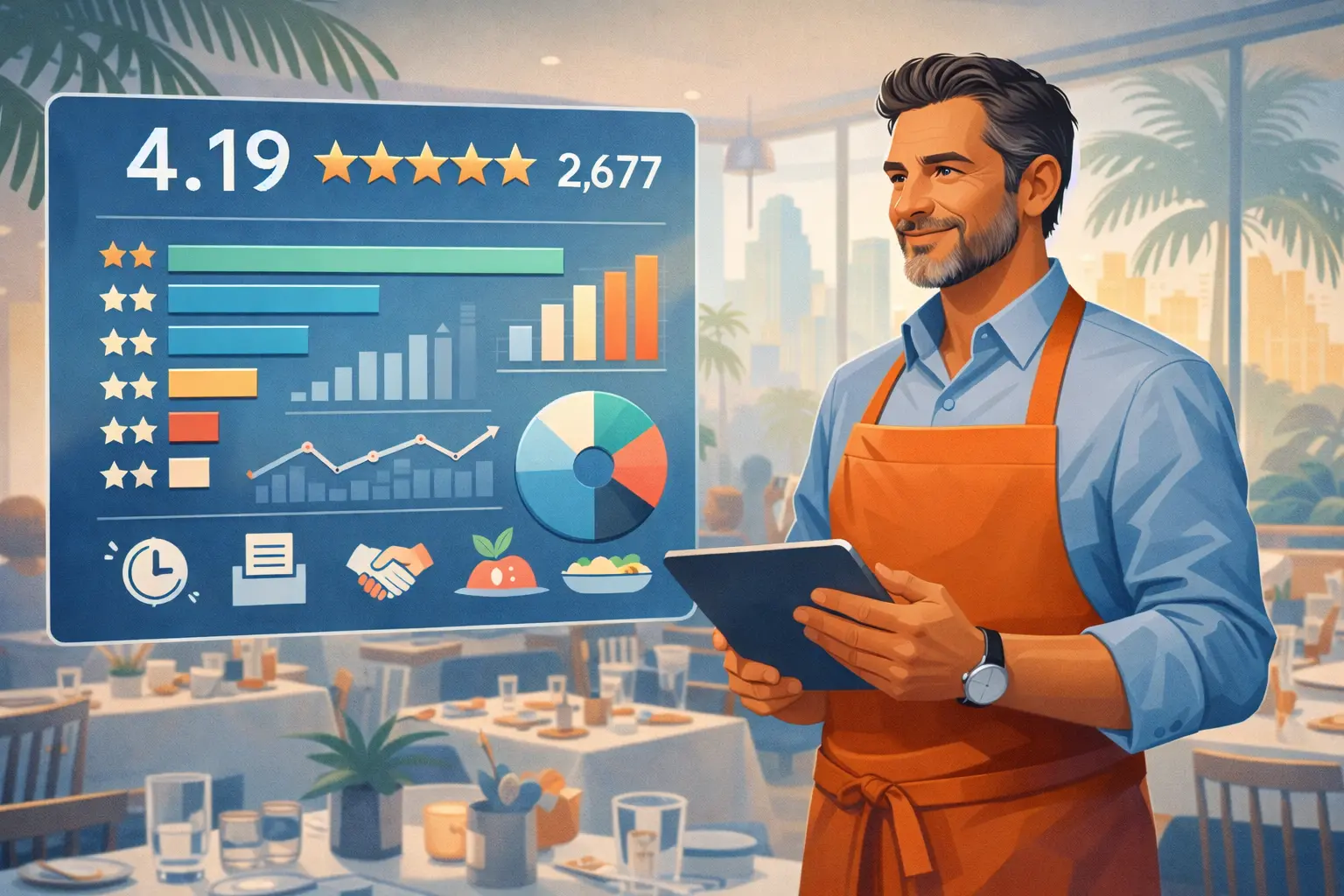
Five-star profiles dominate, yet the average rating still lands at 4.7★. That means Miami guests are generous, but they also expect consistency across thousands of visits. In a market with 100 sampled restaurants, that is a tight race. The average restaurant has 2677.26 reviews, so one bad week does not disappear. To stand out, you need a 4.5★ or higher rating plus steady review volume that keeps your profile active.
Google’s “near me” algorithm favors proximity, relevance, and fresh activity. Updated hours, new photos, and recent replies help you show up when someone searches for lunch in Wynwood or a late dinner in Brickell. That is why miami Restaurants reviews matter beyond the score, they act like proof that you are still in the game. Your listing on the Miami restaurant index is a live storefront, not a static profile.
If your rating sits below 4.5★ with few recent reviews, you can drop below a competitor that is simply more active. A stable 4.5★ with frequent reviews signals reliability to locals who are deciding fast. Consistent flow beats a one-time spike. That is the threshold where you stand out without chasing perfection.
3. Revenue impact of google maps Restaurants reviews miami
Ratings and volume shape demand in Miami, where diners compare several spots before they decide. With an average google maps rating of 4.7★ and 2677.26 reviews, guests see a signal of consistency. That trust supports pricing power on busy weekends and reduces discount pressure on slow afternoons. That is why even small service fixes show up in revenue over time.
What does a 4.7★ rating backed by 2677.26 reviews signal to a guest looking at two similar listings? It says the experience is predictable, so they are more willing to try you at full price. When you add steady new reviews and respond quickly, that signal strengthens and keeps you near the top of the list.
Small improvements compound because each new review carries the story forward. Fix one recurring complaint and the next review reinforces the change, which helps you hold table turns and staff morale. Over time, the lift becomes the new baseline.
4. What Miami customers complain about on Google Maps
- “Slow service and long waits for tables, drinks, or checks, especially at brunch and busy times” (12% of negative reviews)
- “High prices, auto-gratuity, or unexpected service charges that hurt value” (9% of negative reviews)
- “Inconsistent food quality like cold dishes, bland flavors, or small portions for the price” (11% of negative reviews)
These issues show up because Miami dining is fast and crowded, and guests compare you against nearby options in seconds. A small slip during the rush reads as a pattern when it repeats in reviews, especially when volume is high.
Slow service leads at 12%, which fits Miami’s peak brunch and late dinner rushes. When the wait for a table or check stretches, guests feel stuck and post before they even leave. That makes front-of-house pacing your most visible risk.
Price surprises follow at 9%. Auto-gratuity and service charges are not the issue by themselves, but surprise is. Clear menu notes and a quick heads-up at seating reduce the sting.
Food consistency lands at 11%, tied to cold dishes, bland flavors, or portions that feel small for the price. Google Maps reviews are short and immediate, often written on the sidewalk or in the rideshare. The feedback is raw, which is useful because it points to the exact moment that broke trust.
No negative review quotes were provided in this dataset, so there are none to reproduce here. Still, the themes point to operational focus: speed, price clarity, and steady kitchen execution. Fixing one of those shifts the next week of reviews fast.
5. What drives 5-star reviews
- “Attentive, friendly servers who provide standout hospitality” (40% of 5★ reviews)
- “Delicious, well-prepared food with standout dishes and fresh ingredients” (35% of 5★ reviews)
- “Great atmosphere, views, or lively vibe for dining and drinks” (20% of 5★ reviews)
Hospitality leads at 40% of 5★ reviews, which means the server’s pace and warmth are cited wins. Food quality follows at 35%, and atmosphere at 20%, so the experience needs to land on all three.
“We loved the food, Wendy was a amazing host, and her co workers were also so nice, Vanessa and John”
Guests call out standout dishes and a sense of discovery, so menu execution matters.
“OMG the food is absolutely out of this world amazing 😻!!!! I tried their Japanese Ramen and it is the best Ramen that I have had since I came back to America from living in Japan for three years. D…”
The hidden gem feeling shows up with specific menu items and portion satisfaction, so keep recipe specs tight and guide orders.
“10 stars! Their food is delicious. This is a hidden gem in the neighborhood. Their wonton soup is out of this world. And their mama pork fried rice is something you’ll come back for. Their portions…”
Connect these praises to daily behaviors: greet by name, point to a signature dish, and keep the room energetic even on slow nights. That is how you build a google maps rating that feels earned, not accidental.
6. 5 Google Maps-Specific Strategies
Strategy 1: Optimize Your Business Hours
Why it matters: Accurate hours help you win the “open now” decision in Miami, where diners jump between nearby options. With 78% of restaurants already at 5★, small trust signals like correct hours can be the tiebreaker.
Accurate hours reduce calls that tie up the host stand, and they prevent one-star frustration during brunch waits and late-night searches.
Action steps:
- Audit standard, holiday, and event hours in Google Business Profile, and confirm with managers (time estimate: 30 minutes).
- Add a clear note for kitchen close and last call so expectations match reality (time estimate: 10 minutes).
- Set a weekly reminder to update hours before busy weekends and holiday weeks (time estimate: five minutes).
Consistent hours support your near me visibility and keep negative surprises out of miami Restaurants reviews.
Strategy 2: Respond to Reviews Within 24 Hours
Why it matters: Fast replies show you are paying attention, which matters when 12% of negative reviews mention slow service and 9% mention price surprises. With an average of 2677.26 reviews per restaurant, a single response is seen by many future guests.
Replying within 24 hours keeps the feed fresh and supports your google maps rating over time.
Action steps:
- Turn on review alerts and assign a daily owner for replies (time estimate: 10 minutes).
- Use a simple structure: thank the guest, name the issue, and share the fix (time estimate: five minutes per review).
- Track unresolved themes like long waits or unexpected charges and bring them to pre-shift (time estimate: 15 minutes weekly).
Keep the tone calm so guests feel heard.
Strategy 3: Add Photos Weekly
Why it matters: Photos back up what guests praise, 35% of 5★ reviews mention delicious, well-prepared food and 20% mention the atmosphere. Fresh images of dishes, bars, and views make those strengths visible in search results.
With so many reviews per profile, a new photo is a quick way to signal that the experience is current.
Action steps:
- Schedule a weekly photo sweep before service, capturing one dish, one drink, and one room angle (time estimate: 20 minutes).
- Use natural light and keep the background clean so the food is the focus (time estimate: 10 minutes).
- Upload and label each photo with a short, plain caption like “brunch patio” or “ramen bowl” (time estimate: five minutes).
Regular photo updates help improve google maps presence without adding work for the kitchen.
Strategy 4: Use Google Posts for Specials
Why it matters: Google Posts give you a short window to highlight specials directly under your listing. In a city where 78% of restaurants already sit at 5★, that extra space can be the edge that gets the tap.
Posts also show recent activity, which helps your listing show up in local results.
Action steps:
- Pick one offer per week, such as a lunch prix fixe or happy hour, and write a short post (time estimate: 15 minutes).
- Add one clear photo and a simple call to action like “Call to reserve” (time estimate: 10 minutes).
- Check post performance in Google Business Profile and keep the best performing themes (time estimate: 15 minutes monthly).
Use posts to steer slower hours and to keep miami Restaurants reviews flowing after a service week.
Strategy 5: Ask for Reviews at the Right Moment
Why it matters: Miami guests leave reviews when the moment is fresh. With an average of 2677.26 reviews per restaurant, one new review will not change the score alone, but it does signal recent activity to the map.
The praise data shows that 40% of 5★ reviews mention attentive, friendly servers, so the best time to ask is right after that good service lands.
Action steps:
- Train servers to offer a QR card with the check when a guest compliments a dish (time estimate: 15 minutes training).
- Send a same-day follow-up text for reservations and waitlist guests who had a smooth visit (time estimate: 10 minutes daily).
- Track which shifts ask and which shifts receive reviews, then recognize top performers (time estimate: 15 minutes weekly).
These small, repeatable asks support steady review flow without making guests feel pressured.
7. Platform comparison insight
Google Maps captures last-minute, local decisions, while TripAdvisor leans toward planners who are building a shortlist before they arrive. For Miami restaurants, that means Google drives more walk-in traffic and same-day calls, especially near beaches and office corridors. TripAdvisor still matters for visitors who book ahead, but it is a second step once your map presence is steady. For the TripAdvisor-specific playbook, read the TripAdvisor guide for Miami restaurants. Prioritize Google first for speed and visibility, then layer in TripAdvisor responses as time allows. That order keeps your team focused on the channel that affects tonight’s covers.
8. Next steps
This week: Check your google maps rating, read the last 20 reviews, and pick one complaint to fix. While you’re there, confirm hours and photos match this week. Write the issue in your shift notes and tell the team what a good outcome looks like by Friday.
This month: Implement the fix, ask for reviews right after a good table touch, and monitor the listing weekly. Keep a simple log of what changed and what guests mention so you see whether the complaint fades. Share one small win in the pre-shift so the team sees progress.
This quarter: Track rating and revenue together and repeat the process with the next complaint theme. Use the trend to plan staffing and menu focus, not just replies.
If you want a simple way to organize replies and themes, our review tool keeps it in one place without extra steps.
9. Data methodology
All data in this article comes from Google Maps public reviews. The sample includes 100 restaurants in Miami, Florida, collected in December 2025 on December 28, 2025. The platform analyzed here is Google Maps only, and the TripAdvisor analysis lives in a separate report. The rating distribution and average review count reflect what was visible on public profiles at collection time, and results may differ by location within the city. This is a snapshot in time, so seasonal shifts, menu changes, or staffing changes can move the numbers. Individual results will vary by concept and neighborhood. Every statistic and quote is publicly verifiable on Google Maps.